Hire the right crew, not just the available one.
CrewIQ helps construction companies fix the two things that cap growth: recruitment and culture. Build a clear picture of what “good” looks like, hire to it, and understand the team you already have.
Software plus an expert service. Australian hosted. No pricing page, because price is a conversation.
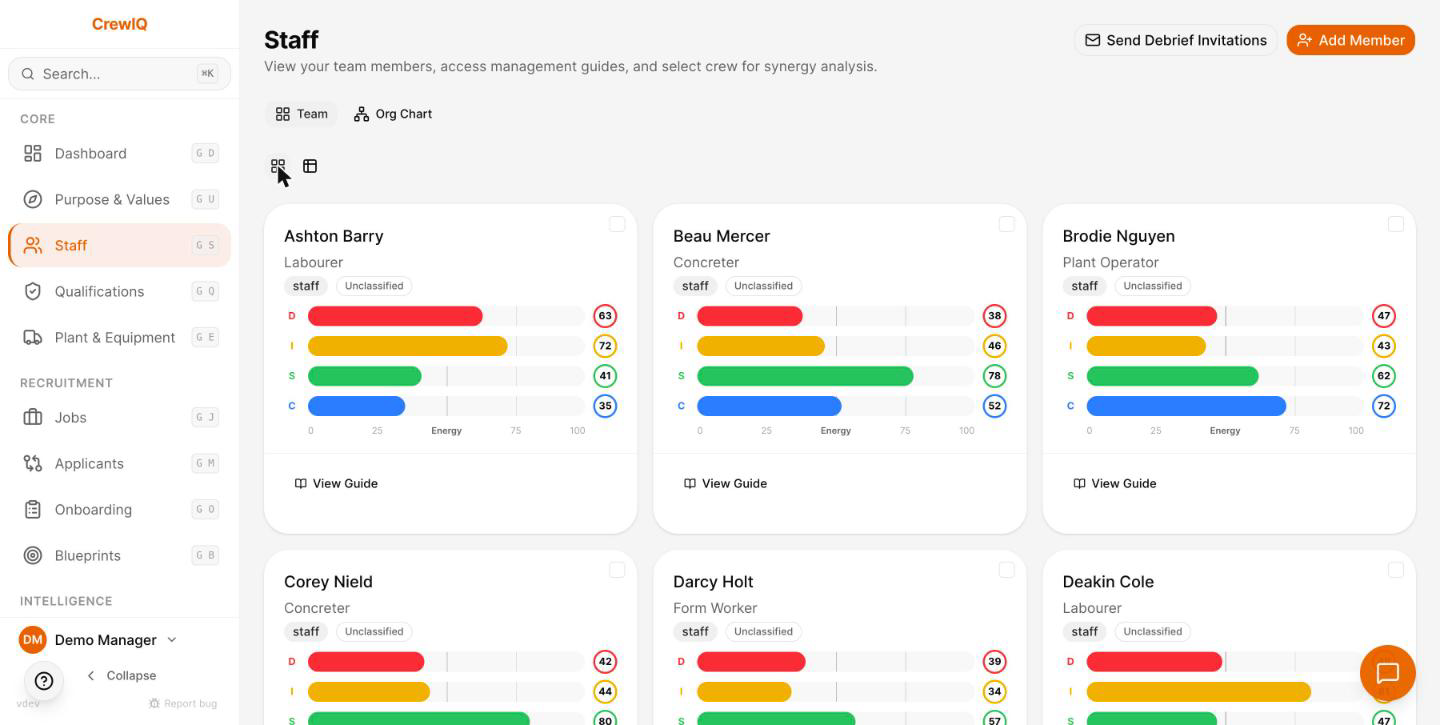
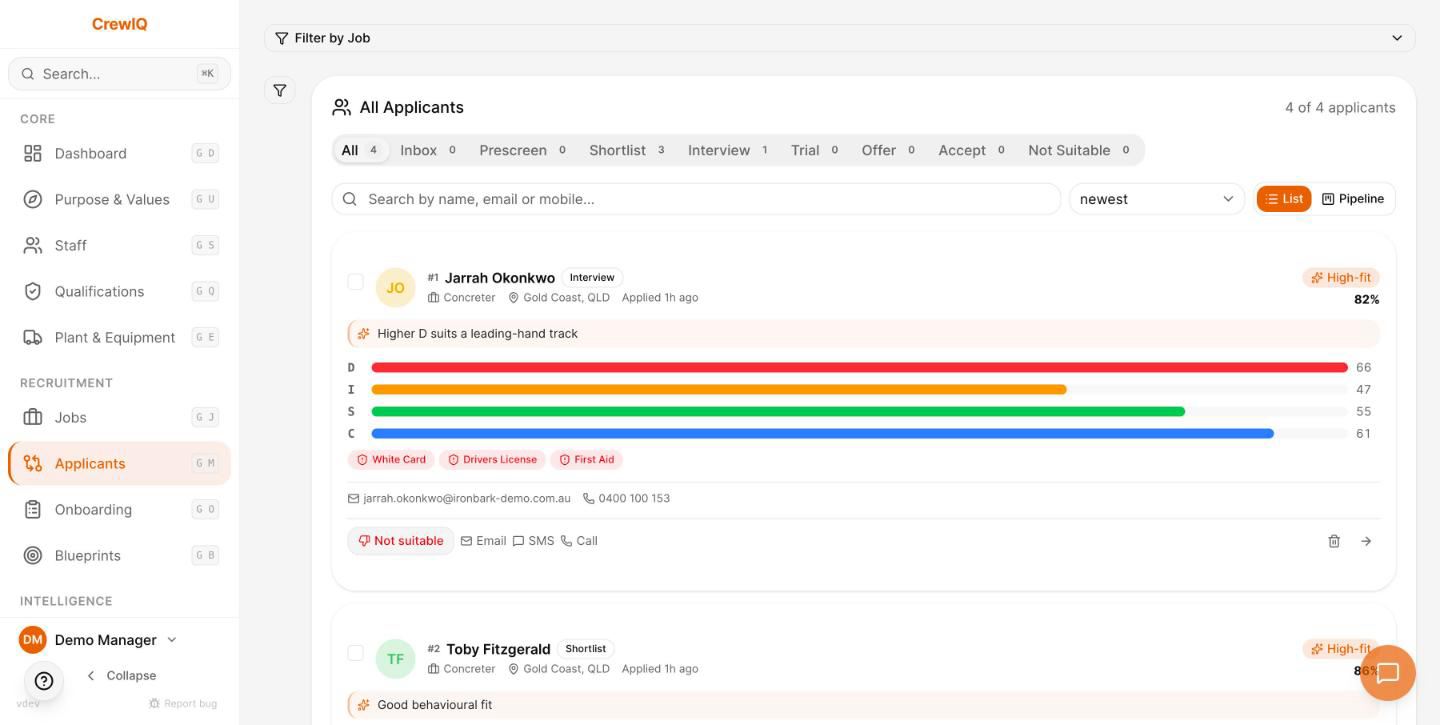
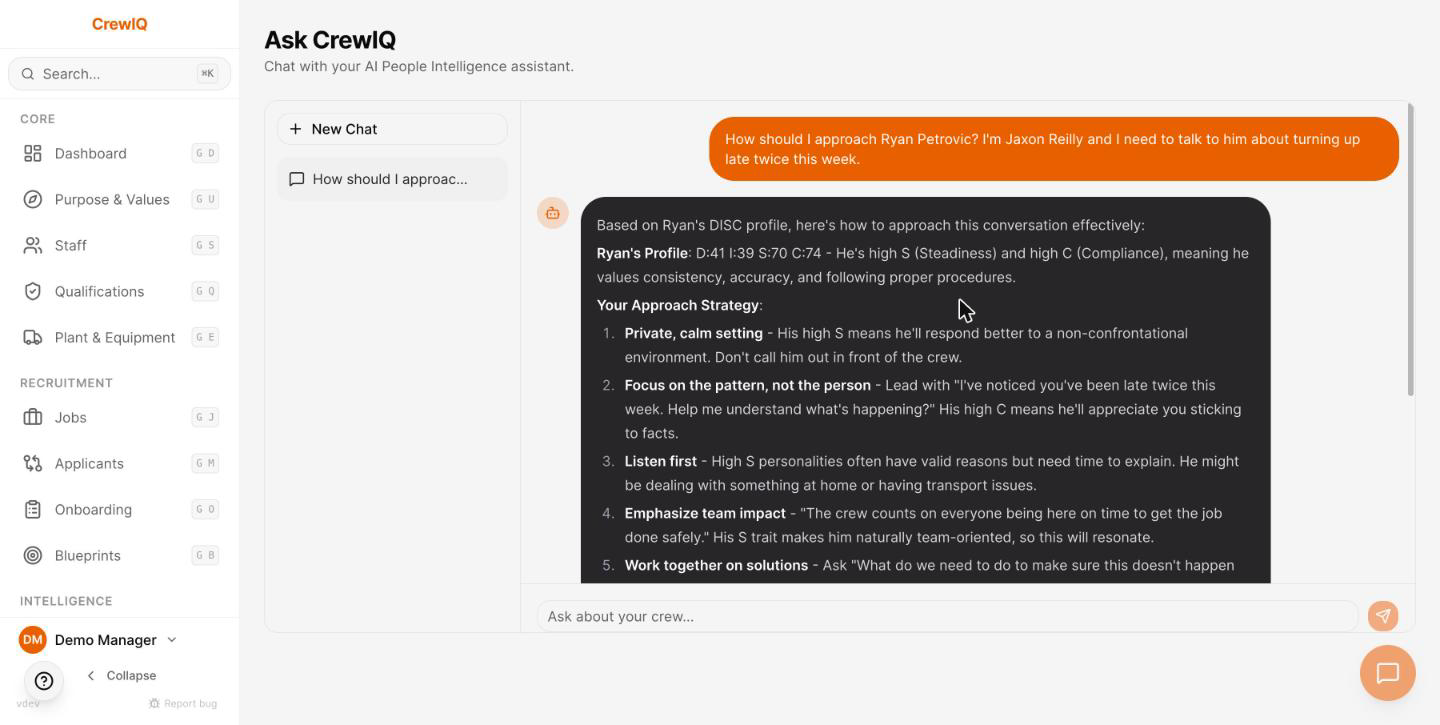
Figures from the Ironbark Concreting & Civil demo tenant. Demo data, no real people.
CrewIQ is recruitment and culture software for the Australian construction industry, backed by an expert service and a pressure-tested methodology, powered by DISC psychographic profiling.
If your business runs on who turns up, you don't have a business. You have a roster.
You grew the team. Then the wrong people started costing you more than the work ever did.
- Good people are rare. No-shows are not.
- Whole crews walk at once, and take the knowledge with them.
- You can feel a bad fit on site, but you can't see it coming before you hire.
- How to manage each bloke lives in your head, not in the business. If you're not there, the call doesn't get made.
You already know you have a recruitment problem and a culture problem. That’s the whole point. CrewIQ is built for the owner who is already feeling it, not to convince a happy operator that anything is wrong.
Software with an expert in the loop.
CrewIQ is not pure software, and we won't pretend it is. It is two things working together.
The software
Runs the system work, always on and self-serve: the applicant funnel, the scoring, the DISC visualisations, the compliance tracking, the AI guidance.
The service
Does the judgement work, expert-led by Chris Hogan, a certified practitioner: the DISC profiling, the behavioural interviews of your shortlist, the culture-alignment work.
The line we hold: the software surfaces and ranks the data, a human makes the people call. That expert in the loop is the reason it works, not a limitation.
Underneath both sits a pressure-tested methodology, built on a real concreting site and baked straight into the software. And the whole thing is powered by DISC psychographic profiling, so the read on your people is behavioural, not a gut feel.
What CrewIQ does not do: no rostering, no timesheets, no GPS tracking, no payroll, no site-safety paperwork. Those are other tools. CrewIQ stays in its lane: recruitment and culture.
Three steps, from gut call to standard.
Step 1
Define what good looks like.
Build a blueprint for a role: the DISC range that actually performs on your sites, plus the mandatory tickets. Or clone it straight from one of your best people. “Hire more like Jake” becomes a measurable standard, not a hunch.
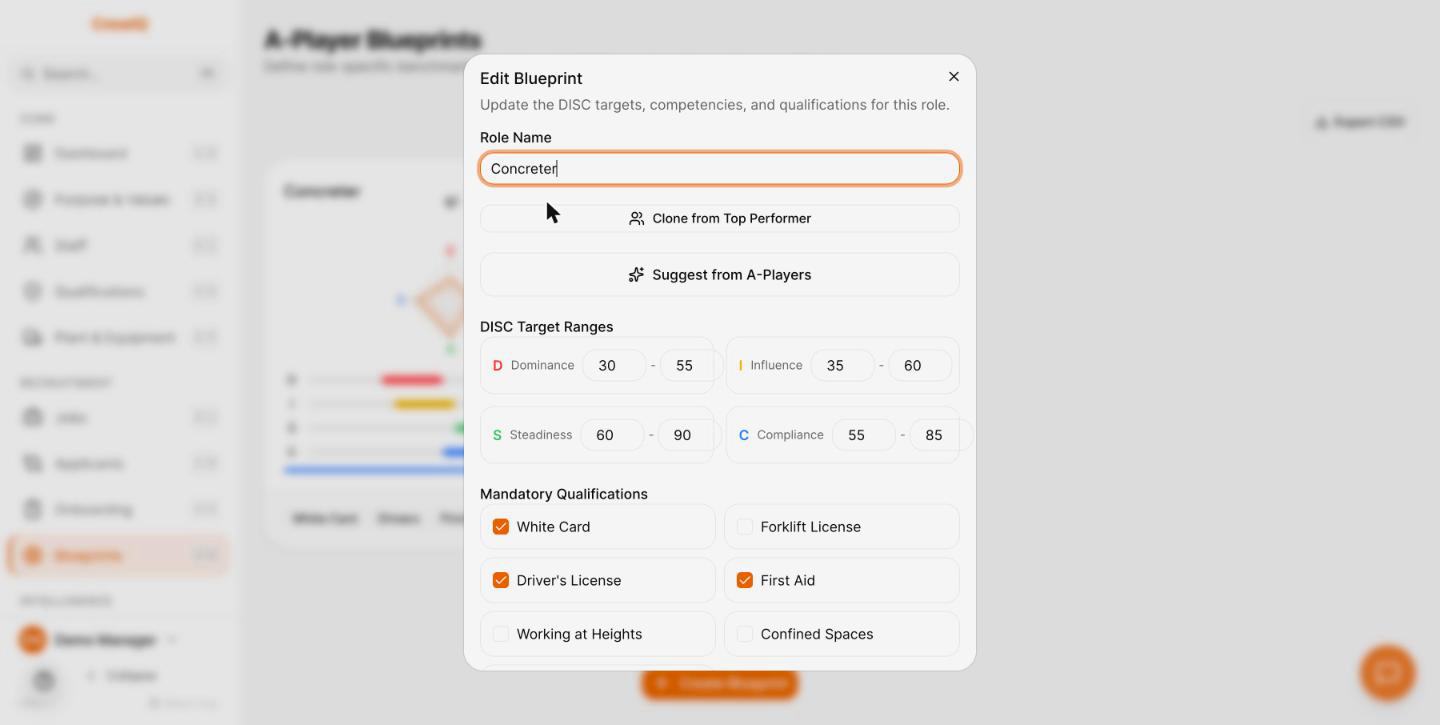
A Concreter blueprint, cloned from a top performer. Target behaviour plus the tickets that are non-negotiable. Step 2
Filter and score the applicants.
A public job board and an application built to be finished in five minutes on a phone. Reference checks and a clear decision pipeline. If someone can get through all that, they’re serious. Then Matchmaker scores every applicant against the blueprint and shortlists the best fits for you. You still make the call. The software just stops you sifting.
Matchmaker ranks applicants against the blueprint. Top of the Ironbark shortlist scores 94 per cent fit. Step 3
Build the crew and lead them.
DISC profiles for your team, shown as clear radar charts, plus a synergy score for any crew you’re putting together. See the friction before it hits the slab. Then get tailored guidance on how to manage each person.
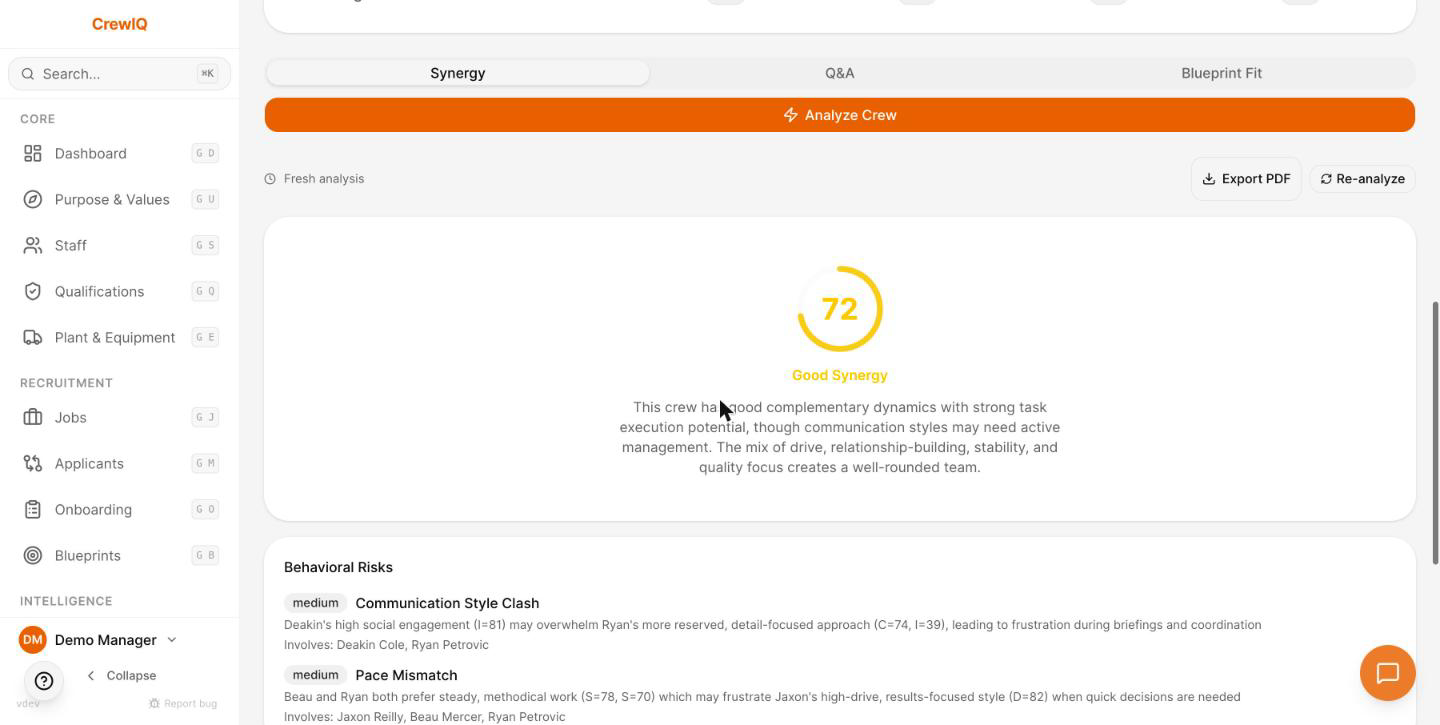
Crew Analyzer scores the synergy of a proposed crew, so you spot a clash before you build the team.
The clever bit, in plain English.
Management guides
Every profile comes with practical, DISC-based advice on how to lead that person. The owner's judgement, written down and available to every foreman.
Crew synergy scores
Propose a crew, get a read on how well they'll actually work together.
Ask CrewIQ
Ask a question about anyone on your team, by text or by voice, hands-free on site. It answers from your team's real profiles and blueprints.
- Built in Australia, on Australian data rules.
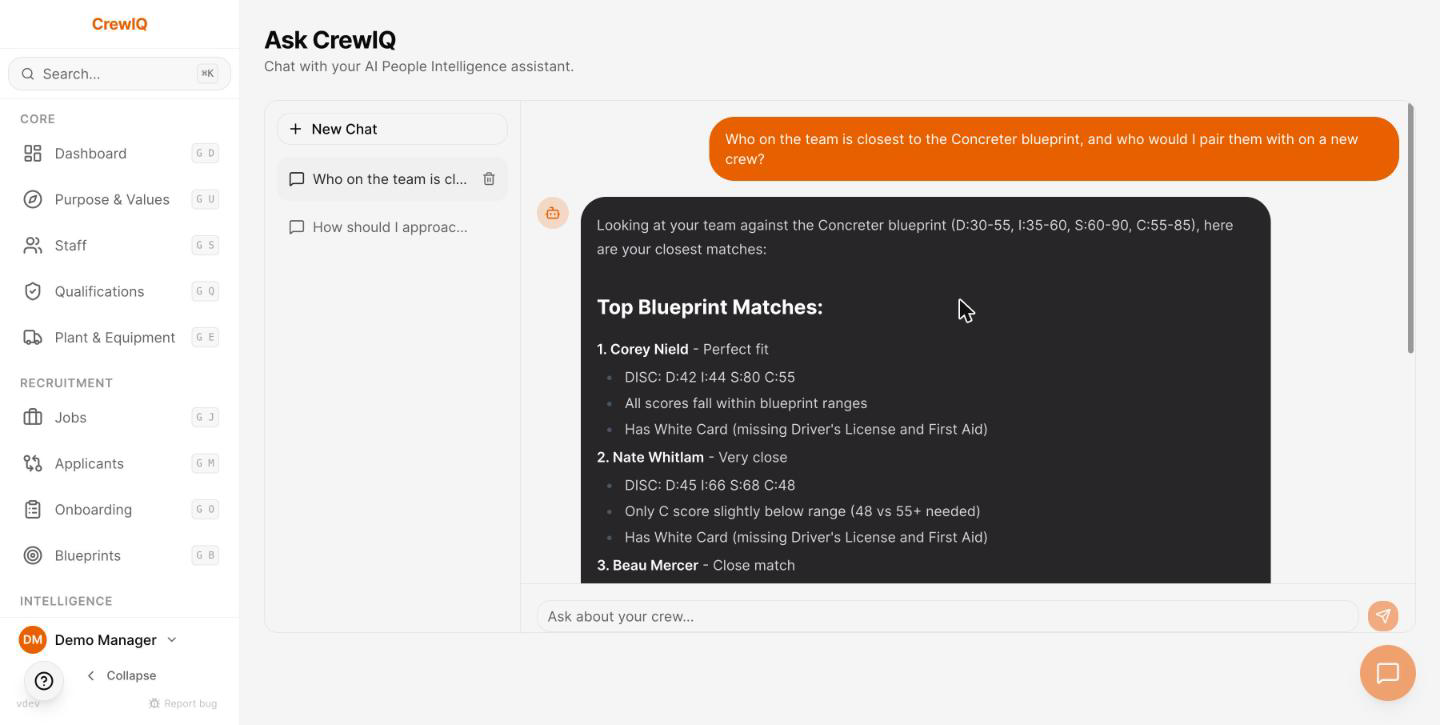
You can’t stick a bloke’s profile on his back. This is the next best thing.
Most friction on site is not a bad attitude. It is two people working to different instructions that nobody ever wrote down. Conversation Coach is unique to CrewIQ: ask it how to approach something before you raise it, and it answers using both profiles, yours and theirs, not generic advice.
What it looks like on site
“Here he comes. He’s going to blow up in a minute.”
And he does. Then five minutes later he is asking how your weekend was, like nothing happened, and half the crew has decided he is a psychopath. Run his profile and it stops being a mystery. He is a high D. Results first, heat fast, over it just as fast. Nothing personal in it, and never was.
“Just get into it, mate.” And he doesn’t move.
He wants to know everything before he starts. To a fast mover that reads as dragging the chain. He is a high C. Give him the detail and the time up front and he goes, properly, first time. You simply stop having the argument.
“I need to pull this bloke up. How should I approach it?”
Ask that and CrewIQ reads both profiles before it answers. Where to have it, what to lead with, how much detail to bring, and what to agree on before you walk away. Same problem, handled so it lands. That is the difference between a bloke who fixes it and a bloke who walks.
So you profile the team. Then what?
The fair question, and the one worth answering before you start. A profile that just sits in a folder is worth nothing to anybody.
The worker gets a plan, not a label
A profile is only the start. Each person sets their own goals off the back of it, with actions and timeframes, and comes back to review what they actually did. Understanding yourself is the point. Everything else follows from it.
The business gets a map
Once you can see the styles across a team, two things get easier straight away. Hiring, because you finally know what your good people actually look like. And day-to-day management, because the friction stops being a mystery.
And what it deliberately is not
- It is not a performance rating, and there is no good or bad profile.
- It is not a file on anyone. A person's profile is theirs, and the point of it is that they understand it.
- It does not single anyone out. The value only shows up when the whole team can see how the whole team works.
- It is not a mental health program, and we do not present it as one.
Assessments are done in a person’s own time, not squeezed into a toolbox. The debrief that follows is where the value lands, and it is a conversation, not a report emailed to a manager.
A method born on a real site, not a manual on a shelf.
Plenty of hiring advice sounds good in a boardroom and falls over on a job site. Ours didn’t come from a boardroom.
The CrewIQ methodology was pressure-tested on a live concreting business as it scaled, through real no-shows, real crews walking, real clashes on the slab. What worked got kept. What didn’t got cut.
Then we baked it into the software. So it isn’t a binder your foremen will never open. It’s the way the blueprints, the scoring and the guidance already work, every day, whether the owner is on site or not.
The things that bite when you're not looking.
Compliance you can see.
Every ticket and certification stored with its type, expiry and status. Expiries surface before they bite, so you never send someone to site out of date.
Culture that survives the growth.
Team purpose, core values and culture scoring give the business a shared language as headcount climbs. The values that worked at six people don’t survive to forty by accident.
Your data stays here.
Your people’s information is sensitive, and it stays onshore. CrewIQ is hosted in Sydney and built to the Australian Privacy Act, including the 2024–25 reforms. Subcontractor data carries stricter access rules again. No fine print, no asterisks.
Read how we handle data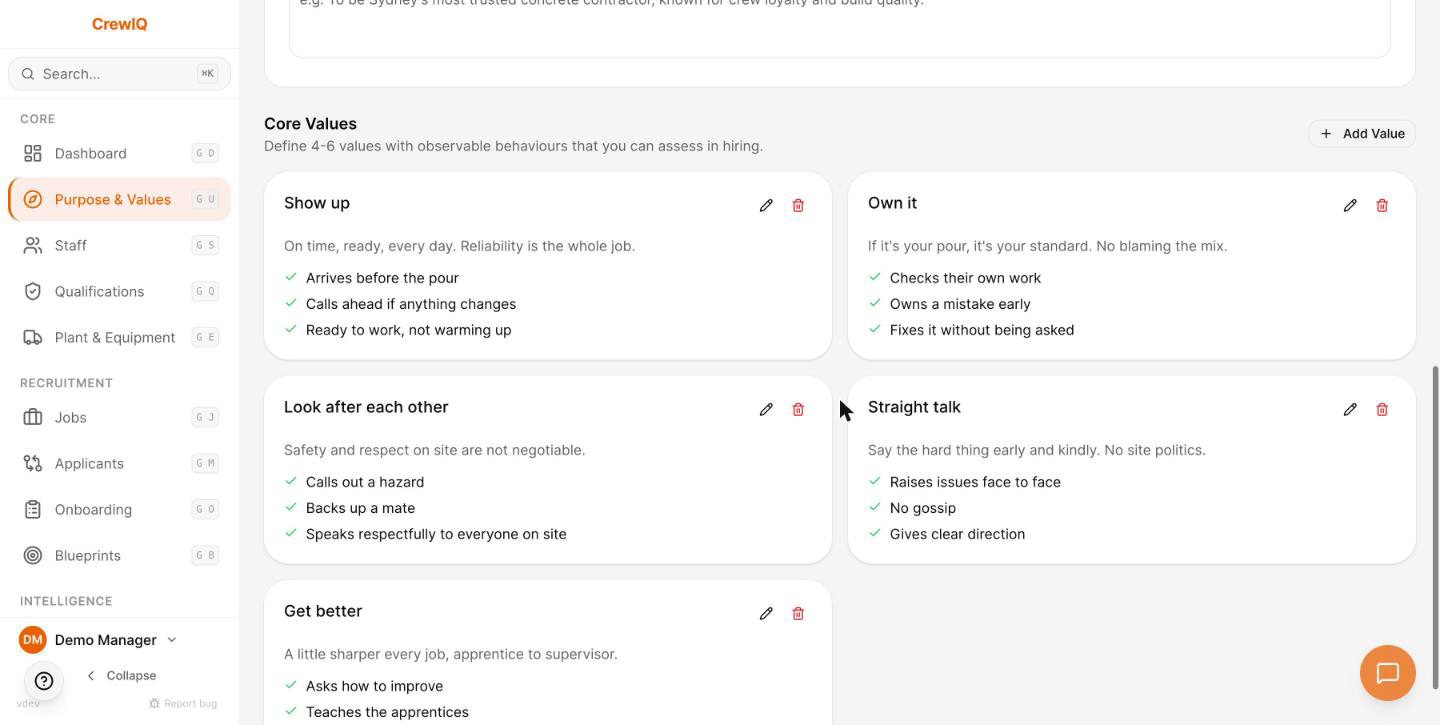
Built on a real site, not a whiteboard.
CrewIQ was built for a Queensland concreting company that grew from a handful of blokes to more than forty, and felt every people problem on the way up.
The workforce became the biggest risk in the business. Whole family groups would walk at once to start their own slab work. There was no way to screen for the right people, no read on how a crew would gel, and the knowledge of how to manage each person lived only in the owners’ heads.
The cost of getting it wrong is real. A bad hire can run past $100,000. A job that falls over can cost around $60,000 in lost revenue. CrewIQ exists so growth stops depending on who’s available that morning.
These figures are the cost of the problem, not a client result. We publish named client outcomes only once they are verified and signed off.
Read the full storySee it working, then decide.
If any of this sounds like your business, we're happy to walk you through it and show you how CrewIQ fits.
One simple enquiry: your name, your business, an email, and a line on where the crew is hurting. No booking machinery, no pressure.